
Everything started in the 19th century, when modern Georgia was not an independent country as it is today. At that time, Georgia had been annexed by the Russian Empire. In 1801, the empire abolished the Georgian monarchy and exiled the royal family, the Bagrationi dynasty, to Siberia. The Bagrationi dynasty had ruled the country since the 9th century. Politically, this marked the end of the Kingdom of Georgia.
However, there was also a paradox. During the 19th century the Russian Empire was strongly influenced by European culture. Russian emperors actively invited European architects, painters, and decorators to work in the empire.
One of them was the Hungarian painter Mihály Zichy. He was born in 1827 in the village of Zala in Hungary. In 1847 he moved to St. Petersburg, where he was invited by the Russian emperor Alexander II of Russia to work as an illustrator for the imperial court.
Later he received an order to illustrate works by the famous Russian writer Mikhail Lermontov, who had lived in Tbilisi for some time. In 1881 Zichy traveled to Georgia to experience the atmosphere of the Caucasus in order to create illustrations for Lermontov’s poem The Demon. However, the publishing project was eventually cancelled and the illustrations were never published as originally planned.
Despite this, Zichy stayed in Tbilisi, and this unexpected turn led him to one of the greatest achievements of his career. He became the illustrator of the masterpiece of Georgian literature, The Knight in the Panther’s Skin by Shota Rustaveli.
For Georgians, this epic poem holds a cultural importance similar to the role of William Shakespeare in the United Kingdom. Zichy created 26 illustrations for a new edition of the book, and Georgian society was astonished by the quality of his work.
The famous Georgian painter Lado Gudiashvili later described Zichy’s illustrations as one of the greatest visual interpretations ever made of the poem.
Zichy himself deeply loved Georgia and the Georgian people. He once remarked that Georgians are very generous: “If you do something for them, they try to do even more in return.”
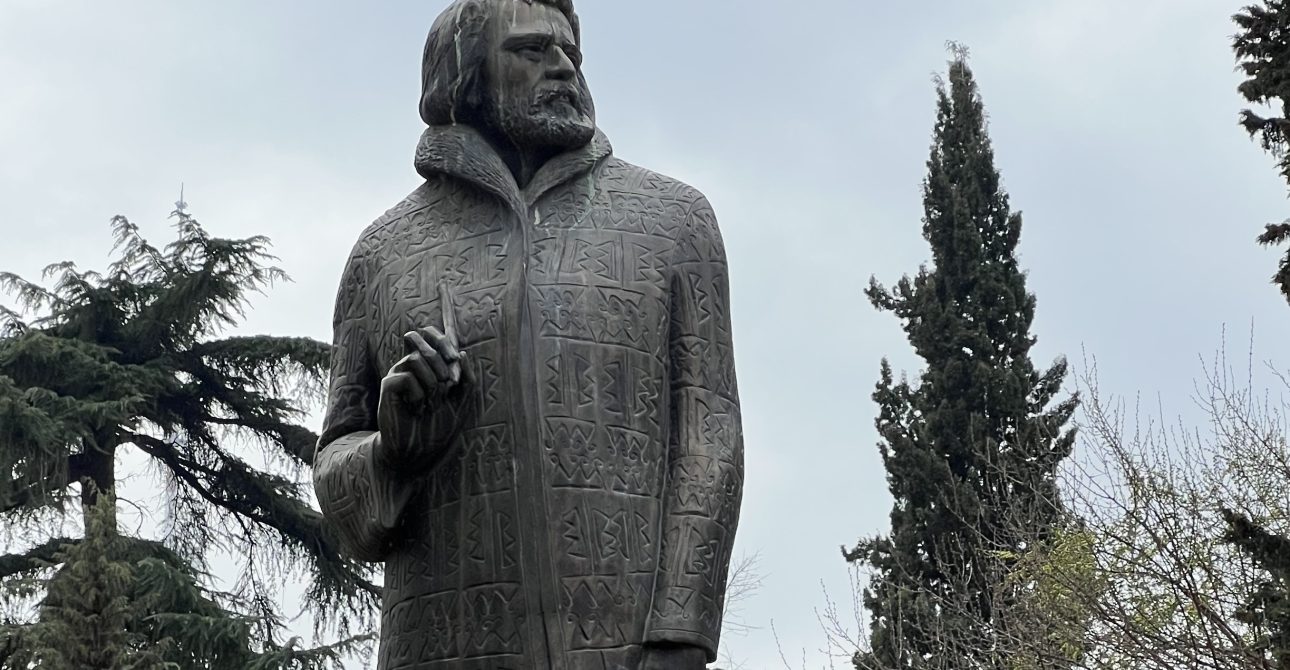
In gratitude, the Georgian people honored him. Today, a statue of Mihály Zichy stands in Alexander Garden, very close to Rustaveli Avenue and Orbeliani Square.
Mukhran Guliashvili – Local Tour Guide Tbilisi
Literature:
Mukhran Guliashvili – Local Tour Guide
1. Beno Gordeziani. Zichy in Georgia. 2nd edition. Tbilisi: “Soviet Georgia” Publishing House, 1966.
2. Guram Sharadze. Mihály Zichy and Georgian Culture. Tbilisi: “Khelovneba” (Art) Publishing House, 1978.